Friday, October 7, 2011

HTRIP: A Year in Review

Dear Supporters,
August saw the completion of tree distribution and planting, a preliminary tool inventory to prepare for an earlier start of this year’s tree nurseries, a final graduation ceremony for HTRIP’s literacy program, a continuation of our monthly education program, and our annual staff retreat to the beach where we focused on developing a long-term strategic plan for the project. 

Learning to read
HTRIP hopes to eventually turn impoverished mountain villagers into tree farmers who market timber products to generate enormous increases in household income and standard of living.  One barrier to success is the fact that most of our program participants are illiterate and therefore extremely vulnerable in the marketplace (in a business transaction, it is easy to take advantage of someone who can neither read nor add numbers).

Teaching adult literacy to help make our participants better businessmen, then, was the logic behind the separately-funded and relatively independent program begun in 2007 under the leadership of Agathe Généus, a dynamic an innovative teacher and community mobiliser.  Since then, Agathe has been bringing her unique curriculum far into HTRIP’s mountain communities.

On the 11th of August, we celebrated the achievements of those members of HTRIP communities who completed the two-year literacy program.  At a graduation ceremony not far from the location at Drouin where we held one of the HTRIP agro-forestry graduation ceremonies last May, each community prepared a song, dance, or skit about the importance of literacy—and all of them featured new graduates reading aloud in front of the entire group.  Unfortunately, funding is no longer available to continue this program, but the learning is not over.  HTRIP’s philosophy stresses community empowerment, and Agathe’s work involved training local instructors to go back to their respective communities to teach literacy to their comrades.  We are confident that even though the formal program has concluded, its impact will not end now.  We hope that it will continue for years to come and prepare our participants for the marketplace.
Everyone on the HTRIP team is enormously grateful to Agathe for her important contribution to our mission, and we will keep her onboard as an informal consultant until another lucky program lures her away from ours. 


HTRIP gets greener
Since clean drinking water is difficult to get around Deschappelles, most Haitians (at least when they are out and about at the market or at work) hydrate with purified water sold in small quarter-litre plastic bags on the streets for a few gourdes.  Predictably, the used and discarded water bags (sache dlo in Creole) litter the streets.  This month, HTRIP began reimbursing locals for collecting these sache dlo for eventual use in HTRIP central and community nurseries as growing containers for our tree seedlings.  We pay 25 gourdes (about $0.50) per 100 sache dlo, compared to 120 gourdes (on average) for the more expensive black seed bags we used to buy in Port au Prince.  Although the difference (about $2 saved per 100 bags) seems small, when you consider that we plan to acquire nearly 350,000 tree seedling bags this year, it amounts to considerable savings… and the only side effect is and pocket money for the entrepreneurial Artibonite children collecting the sache dlo, not to mention less littered streets.

Passing the half-million mark (with ninety-thousand to spare)
While the literacy program concluded, the regular HTRIP tree-planting work continued to roll forward.  HTRIP staff personally moved 31,085 trees in July and August, mostly from our central nursery in Deschappelles, but also to some extent among communities in the mountains.  Much more significant is the number of trees that communities produced and planted for themselves: all told, we produced and planted 221,139 trees this year, by far our most productive year to date, bringing our grand total to 591,888 trees since 2006.  At this rate (we intend to produce and plant more than 300,000 this coming year alone), we will be well passed the one-million mark by the end of 2013.

Planning for HTRIP’s future
Speaking of planning for the future, HTRIP is proud to announce the progress it has made in its long-term strategic planning.  On the 17th of August, HTRIP staff gathered with its consultants for a day-long brainstorming session at a beach resort near Saint Marc to set concrete goals and policies for 2011-2012 and design a long-term HTRIP strategy.  The Year 6 strategic plan evaluates program performance since 2005, articulates specific targets for this fiscal year, and outlines a long-term strategy for HTRIP over the next fifteen years.  The final document will be available in mid-September, but here are some of the highlights:

   2005-2011 accomplishments:
    • Educated 2,818 men and women about agro-forestry and helped them plant more than half a million trees and construct more than 100 kilometres of soil conservation;
    • Built a tightly-knit team of consultants, drivers, and agro-forestry technician/extension agents;
    • Developed a solid model for agro-forestry education, tree plantation, and soil conservation flexible enough to sustain in the long term; and
    • Dramatically improved operational efficiency (in 2006-2007, we required nearly five dollars in our annual budget for every tree planted under the HTRIP aegis; in 2010-2011, that figure dropped to nearly one dollar).
   2011-2012 project goals:
    • Continue our successful tree-planting programme with 44 active communities, graduating more than 1,000 participants and planting as many as 350,000 trees, including work in the remote and inaccessible 6th section of Verrettes (localities like Barbe, La Bonne, Terre Nette, Gabriel, etc.), where we will need to adapt our programme to the area’s geographical and logistical limitations;
    • Convert 85% of the seedling containers that HTRIP uses to the cheaper and more eco-friendly sache dlo “water bags” and reduce the targeted cost per tree produced by 25% compared to 2010-2011;
    • Build a larger and better nursery (see right) that will give HTRIP more efficiency for materials management and distribution, and—more importantly—afford it the space to develop a grasses initiative and experiment with several new tree species;
    • Expand last year’s shade-crop trial to 6-12 more communities to continue our initiative to make HTRIP tree plots more productive until they are ready for harvest;
    • Offer regular staff development opportunities so that HTRIP staff is prepared to better contribute to the new programmes we are developing; and
    • Engage in another year of successful collaboration with the Yale School of Forestry and Environmental Studies on long-term HTRIP goals (see below).


Thank you all for your continuing support,
 The HTRIP Staff,
including Starry Sprenkle, Dan Langfitt, and Paul Tompkins

Friday, August 19, 2011

HTRIP Highlights!

Dear Supporters,

We kicked off our 2011-2012 cycle of HTRIP activities on the 1st of July with a gathering of all fifty-five HTRIP community leaders. We will be working closely with forty-three communities that may graduate as many as 1,300 people this year, and we are already projecting to produce and plant as many as 380,000 trees. At the same time that we began education sessions and planned for the coming year with community leaders, we finished other summer activities to close out our 2010-2011 cycle—our final demonstration tree-planting in Barbe (on the 11th), routine experimental plot data collection (completed last Tuesday), continued sponsorship of strategic road repairs, and collection of nursery production data and tree distribution (still in progress).

HTRIP team itself does not plant very many trees—our philosophy is based on the premise that communities should be able to plant and maintain tree plots on their own—and when we finished our tenth and final demonstration plot of this year in Barbe (a remote and particularly impoverished village in Verrette’s 6th section), we reached our total of 1,863 trees for the year.

But the other shoe is coming. The trees that HTRIP technicians were involved in planting personally represent less than one hundredth of the total we expect our most recent group of program graduates to plant on their own land this summer. Thanks to the leverage that our model affords us, we can expect as many as 250,000 trees to be planted under HTRIP’s aegis this year alone. It will take months to compute the nursery production totals and survey over eight hundred new filial plots, but when the final numbers come in, we expect 2010-2011 to have been our most productive year so far. And we will do even better in 2011-2012.

While participating communities were busily planting trees this month and last, the HTRIP staff accomplished a remarkably efficient round of data collection in a spatial tree-planting experiment that was installed by Starry Sprenkle and several interns in the summer of 2009. After only two years, we already remark at the unexpectedly strong performance of the mahogany trees we planted (they continue to grow during the dry season, unlike the cedar and flame trees, and the “slow-growing” mahogany actually grew more than the other two “faster-growing” species during the first year—though in the second year they were outstripped by the flame trees). Preliminary data suggest that trees have higher growth rates and more photosynthetic activity when mixed evenly with other species, rather than planted in monocultural clumps. It is great news that preliminary conclusions like this can be available so quickly to help HTRIP better advise its participants about planting strategies, but those of us measuring the sometimes gargantuan two-year-old trees (see picture), it does not come as much of a surprise.

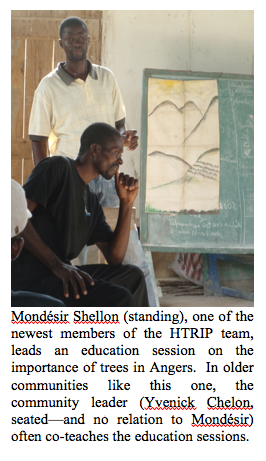
This month began the 2010-2011 education cycle, and the first lesson is always devoted to enpòtans pyebwa yo—the importance of trees—and an orientation to the HTRIP program. Community members learn about the causes and consequences of deforestation (for instance, charcoal use leading to soil degradation), the utility of trees (for everything from building furniture to moderating temperature), threats to tree survival (like free pasturing of livestock), and how to protect trees from those threats (tie up your goats). The lesson for August covers general care of trees.

While the tried and true HTRIP cycle of education, nurseries, terrain improvement, plantation, and follow-up is in full swing in forty-three communities this year, nine older communities that started working with us in 2006 and 2007 are piloting a more independent phase of their relationship with HTRIP. In communities like Salasse and Cayhuit, HTRIP has already been able to offer its education program to most people who are interested in planting trees (123 people in Cayhuit between 2007 and 2011!), and some community members are already planting third and fourth tree plots on their own initiative.

HTRIP is committed to developing its program in response to community needs, and as we no longer need to hold the hands of older communities as they install micro-terracing and tree plots (at which they have become quite proficient), we can focus on finding ways to make their young agro-forestry parcels more productive. Last month we installed a small pilot experiment in Source du Pont to test the viability of several shade-tolerant crops that could be ideal for planting in other young tree plots where canopy cover is significant enough to rule out traditional corn and sorghum. Paul Tompkins joined us this month from California, where he recently received his Master’s degree in Marine Science. Paul specialises in restoration ecology, and during his two-month internship he will help HTRIP plan an expansion of these shade-crop trials to ten or fifteen communities next summer.

Furthermore, we recently launched a comprehensive programme evaluation to generate a detailed plan for HTRIP over the next four, five, ten and fifteen years, through crop diversification to timber harvesting. Since 2006, we have developed a successful model for introducing basic reforestation and agro-forestry in the mountains around HAS, but as we continue to sustain that model—taking on new communities each year and progressively “graduating” old ones—it is time to look to the emerging needs of our communities, needs like shade-tolerant crops and (eventually) timber harvesting and marketing methods. This level of programme planning requires much discussion, reflection and (yes) sifting through data, but we hope to have a full report ready during the month of September. In the meantime, we welcome your questions and suggestions.

Thank you for your continuing support,

The HTRIP Staff, including Starry Sprenkle, Dan Langfitt, and Paul Tompkins.


Honoree Profile: Ralph Greco, MD

Each year, the Friends of Hôpital Albert Schweitzer Haiti salutes a member of its community of friends who has demonstrated outstanding commitment to our cause.

This year, we are thrilled to honor Dr. Ralph Greco for his constant support and philanthropy, and thank him for his many years of friendship and service on behalf of HAS.

For almost four decades, Dr. Ralph Greco has been providing volunteer medical care and material support to the underserved Haitian community of the Artibonite at Hôpital Albert Schweitzer Haiti. Dr. Greco first encountered HAS Haiti in 1970 as a third-year surgical resident at Yale. He admits, "It was initially a bit intimidating, but surgical residents in that era never admitted such things. I did fall in love with the children and liked Haitian art." To his surprise, Yale again sent him back to HAS in 1971, where this time, "it was an exhilarating experience." He operated on "great cases" and felt "a tremendous sense of accomplishment." From then on, he was "hooked -- infected with the 'Haiti virus.'"

After completing his training at Yale, he continued to visit Haiti and HAS. In the 1990's, as Director of the Surgical Residency Program at the Robert Wood Johnson Medical School, he began a rotation at HAS for his own surgical residents. In 2000, he left for Stanford and again implemented a residency program for medical residents there. In each environment he was thrilled by the results, as was HAS. He says, "To my great satisfaction, they loved it for the same reasons I had many years before ... For young surgeons, being able to make a diagnosis with just your eyes and hands, and cure someone with an operation, without which, the patient would likely die, is the greatest possible accomplishment."

In 2000, Dr. Greco was recruited to the Stanford University School of Medicine as the Johnson and Johnson Distinguished Professor, Chief of the Division of General Surgery and Director of the Stanford General Surgery Residency Program.

Several years ago, Dr. Greco helped to organize the Haiti week at Stanford, which attracted a number of luminaries from the worlds of medicine and liberal arts for a week-long seminar in Haitian Culture, art, and medical practice, and included a Friends' art auction in his home. More recently, the Palo Alto Art Center displayed his personal Haitian art collection, which once again drew attention to Haiti and HAS.

After the January 2010 earthquake, Dr. Greco was instrumental in raising over $350,000 from the Stanford University community for Hôpital Albert Schweitzer for medical care and disaster relief. Since then, he continues to be involved with HAS in his role as advisor to medical students and residents on opportunities and goals in international healthcare. Greco writes of this time, "Being able to mobilize the Stanford community to help HAS in the aftermath of the earthquake was my way of giving back for the so many things HAS has given me."

A leader in many disciplines, including the arts as well as medicine, Ralph has inspired several generations of surgeons to pursue excellence in clinical care and to consider the needs of the less fortunate of this world. "Haiti," he says, "is a part of my life and always will be." Indeed, Haiti, and Hôpital Albert Schweitzer is by far richer in spirit because of Dr. Ralph Greco’s dedication and service.

Dr. Greco and his wife, Dr. Irene Wapnir, live on the Stanford campus with their daughter Ilana, 17 and are frequently visited by their sons, Eric, 19 and Justin, 22, both college students. Irene is a Breast Cancer Surgeon and visited Hôpital Albert Schweitzer with Ralph in 1996. A native of Argentina, Irene loves hiking and tango. Ralph continues to sculpt in stone and wood and has recently taken up ceramics.

Wednesday, August 17, 2011

New Sounds from Haiti


Sound engineer Aaron Hachen setting up equipment for the Prestige album recording in Deschapelles, Haiti

Part of our mission at the Friends of Hôpital Albert Schweitzer Haiti is not only to raise awareness for the great need in Haiti, but also bring the more beautiful parts of Haiti into the spotlight. We bring Haitian artwork to the US, and showcase the visionary creativity of the Haitian people. We also send photographers to Haiti, so that they might capture another aspect of this beautiful country. So preoccupied with the staggering visual beauty of Haiti, we sometimes forget the vibrant creative culture in other realms -- music, for instance, and dance. Music is so a part of Haitian everyday life, especially in the more rural areas which we serve in the Artibonite Valley.

We are thrilled to be able to share with you some new recordings from two up-and-coming musical groups in our very own Deschapelles, Haiti: Prestige Band and AMBASSADEUR. Nicolas Atkins, the director of our newest project, the Philip Craig Arts Program, together with sound engineer Aaron Hachen co-produced two albums, and the results are nothing short of fabulous. Learn more about the recording process on PCAP Haiti's Blog.

You can listen to the recordings from AMBASSADEUR here. Prestige's full debut album, titled Ansam N'ap Avanse, can also be heard here.


The 20-part vocal harmonic group, AMBASSADEUR practices before their recording session.


Friday, July 8, 2011

HTRIP Highlights!


Dear Supporters,

It is perhaps appropriate that after a month of earnestly wishing for any rain at all, our plans at the beginning of this month were scuttled because we received too much. Heavy rainfall makes many of the roads going to HTRIP communities dangerous or even impassable, but after a shaky start we held thirteen konbit, planted experimental crops in an old HTRIP demonstration parcel, organized several kilometers of road improvements, and made the final preparations to begin our 2011-2012 education cycle on the 1st of July.

In older HTRIP plots, the tree canopies have begun to close enough to create substantial shade. This is great for the soil and wildlife (including people!), but for those farmers who want to continue to practice agro-forestry, it poses a challenge for growing the traditional regime of corn and millet. That is why HTRIP, with guidance from the Yale School of Forestry, installed a small-scale trial of several shade-tolerant crops in its demonstration plot at Sous Dipon (planted 2006) at the beginning of the month. If the yams, taro, beans, and cacao trees are successful, we will incorporate them into a wider-ranging set of experimental plots next year throughout all our older communities to introduce HTRIP farmers to healthier and higher-value crops.

Our traditional May and June activity is tree planting (see pictures at end). Compared to the back-breaking terrain improvements we build at the end of the dry season, digging holes, planting trees and installing fencing is relatively tame work, and these tree plantation konbit are one of our favorite parts of the year, and a great way to begin a relationship with our newest communities. This year we also reinvigorated a few older communities by giving them a fresh start with a new demonstration parcel. All told, the HTRIP team itself planted some 1,600 trees this month. More important than the trees HTRIP planted directly this month, participating communities began planting tens of thousands of trees in their own filial plots—how many we can’t know for sure until we finish surveying all the parcels, but current estimates put us and our communities on track to have produced and planted over 250,000 trees by the end of the summer. The only new demonstration parcel we have left to plant is in our most remote community of Barbe, where road conditions have made it impossible for our cars to reach so far—we have several dates scheduled for the beginning of next month.


Anyone who has been here will testify that Haitian roads are abominable. That’s why we invest in large, heavy, durable (and expensive) vehicles. Even our redoubtable Land Cruisers, however, cannot climb some of the hills that HTRIP has to contend with, at least not during the wet season when rain washes out whole sections of road at a time. We are still committed to reaching the communities we serve and they are just as interested in having our cars get to them, so we leverage our leftover food resources to make it a little bit easier for communities to rally the workforce to repair the roads on their own. Recent work we organized near Damier might give you an idea of how far each marmite (~5.5 lbs., for rice) of HTRIP food goes with invested HTRIP communities: four teams of twenty people each are working for five eight-hour days apiece to re-grade almost a kilometer of impassable switchbacks and build water bars and drainage canals to slow down further erosion—hard physical labor with picks and sledgehammers (HTRIP is also loaning them the tools). In exchange, each worker gets a meal of beans and rice for each day he or she works. At current food prices, that’s 3,200 man-hours for $230, folks. You do the math.

We have had a steep learning curve since we got started in 2006, and nothing better illustrates how well we’ve learned to leverage our funding than the food-for-konbit model we developed to organize large work forces to install contour canals or rebuild roads. However, this month marks the end of our 2010-2011 fiscal year, and we need your continuing support to make our exciting new initiatives (like shade-tolerant crops) in 2011-2012 a success.

With your support, we will kick off the beginning of a new cycle of HTRIP activities tomorrow with a meeting of fifty-five HTRIP community leaders to plan our education program for the coming months. We could graduate as many as 1,300 people from our program next year, and we are already projecting to produce and plant 380,000 trees with your help.

Thank you,

The HTRIP Staff, including Starry Sprenkle and Dan Langfitt


All photos courtesy of Dan Langfitt

Above: the several trees already present in this demonstration plot at Cagile will help the trees these community members and HTRIP staff are planting (below) to grow faster in a well-documented consequence of nearby trees on new growth called, logically enough, a "nurse tree" effect. While others were rescheduled due to impassable roads, Cagile turned out to be our first planting konbit of the season on 8 June.


Left: A boy carries tree seedlings to an HTRIP technicians at a konbit at the new HTRIP demonstration plot at Drice (held at 15 June). We prepared the terrain with contour canals and rock walls back in March, and now that the rains have come al that is left is to plant.

Right: A woman at Drice plants a frenn (paradise tree) in the demonstration plot near the fence the community is building to keep foraging animals out. We usually plant hardier, faster-growing timber species like frenn or sèd (Spanish Cedar) near the outside of the plot and more fragile fruit trees like citrus species (and this year, coconut trees) closer to the center.

Below: Our last konbit of the month was held this morning on what is undoubtedly our steepest demonstration parcel for 2011, in the community of Dauphiné, a few kilometers above the HAS mountain dispensary at Tiennes. The only planting konbit still on our schedule is for the even more remote community of Barbe, where heavy rains forced us to repeatedly reschedule planting. We are hoping to finish in the beginning of next month.


Tuesday, June 7, 2011

"Thoughts on Haiti"

The following are images of paintings created by artist and PCAP Haiti program sponsor Philip Craig after his trip to Haiti. Stay tuned, there are more to come!


Monday, June 6, 2011

Attention! Looking at Cholera in Haiti with photojournalist Martha Rial

We are seeing an upsurge in cholera patients at HAS Haiti. Today there were fifty new cases, which is back to the peak levels of the November 2010 outbreak.


The following is a guest entry by Pulitzer Prize-winning photographer Martha Rial, who journeyed to Haiti earlier this year to document the effects of the cholera outbreak on HAS and the people of the Artibonite Valley region. Her audio slideshow brings both her words, and the problem of cholera in Haiti to life.

I was not sure what I was going to find when I arrived at the cholera unit at Hôpital Albert Schweitzer Haiti (HAS) in January. It was Sunday morning in Deschapelles and I could hear voices singing praise in the distance. My assignment was to tell the story of cholera’s impact. Within seconds a young man arrived carrying an elderly man in his arms. As the nurse struggled to find a vein on his bony arm, my 16-year-old translator, Stephanie, murmured “Kolera. He may not make it.” His eyes were vacant. It was as if he was already gone.

This was a typical morning at the HAS cholera unit. Although dry season had settled in the valley, patients with diarrhea continued to arrive from all over including the nearby mountains. Paul, the elderly man who had just arrived, was lucky. He lived in the nearby village of Bellanger and had the means to get to the hospital quickly. Cholera victims can die within hours of contracting the disease because they lose body fluids so quickly. HAS staffers are especially concerned about villagers living in the mountains. They have the least access to clean water and sanitation and the journey to the hospital can take hours.

Several hours later, I walked over to Paul’s cot debating whether or not to take more photographs of him. Although I have been a photojournalist for many years, I still worry at times if my presence is intrusive. My concern quickly dissolved when he opened his eyes and smiled. Amazing. His recovery had begun. When I told Stephanie about my surprise, her eyes sparkled with pride and she replied, “That’s what we do here.”

The children’s cholera unit was also a busy place. There was one little boy that had Stephanie especially worried. He was alone and not getting any better. Where was his mother? Family members play a big role in a patient’s recovery at HAS. They are responsible for feeding, bathing and doing the patient’s laundry. Later we found out that his mother had cholera too. This scenario has become too common in the Artibonite Valley.

On my last day in Deschapelles, Stephanie and I traveled to Bellanger to visit Paul. After five days, he had recovered enough to be released. After we were dropped off along the main highway, we followed a dusty road past bean fields into his village. Stephanie knew the area well because she had spent time there as a child. We found Paul sitting in front of his home taking a break from sweeping the yard with a broom made from palm fronds. His daughter Idele fussed over him and children seemed to suddenly appear from everywhere to watch the blanc (white) photographer in action. One of my favorite things about collaborating with HAS is visiting former patients at home. I believe the best way to understand the hospital’s role in the region is to explore the countryside and talk to people. In Haiti, the art of conversation is very much alive.

People always ask me why I keep returning to Haiti to photograph. Why not go someplace new? It is a fair question, but not easy to answer quickly. There are so many reasons I am drawn to this spiritual and complicated land. It is the Haitian people who have made my visits so memorable. People like Paul continue to inspire me with their perseverance and joie de vivre despite the many hardships they face on a daily basis. I can’t wait to go back!