Wednesday, February 29, 2012

February HTRIP Highlights!


Dear Supporters,

February has come and gone full speed. While continuing the ongoing and demanding work of filial plot control, we have also begun organizing food distribution among our communities for our soil conservation konbits and we have started our annual outreach to new potential HTRIP communities.  Our new nursery is up and fully operational, and the array of daily activity under the oversight of Gerard Alvarez foreshadows just how busy we will be in the coming months as we deliver our expected 60,000 tree seedlings when the rains starts around May. 
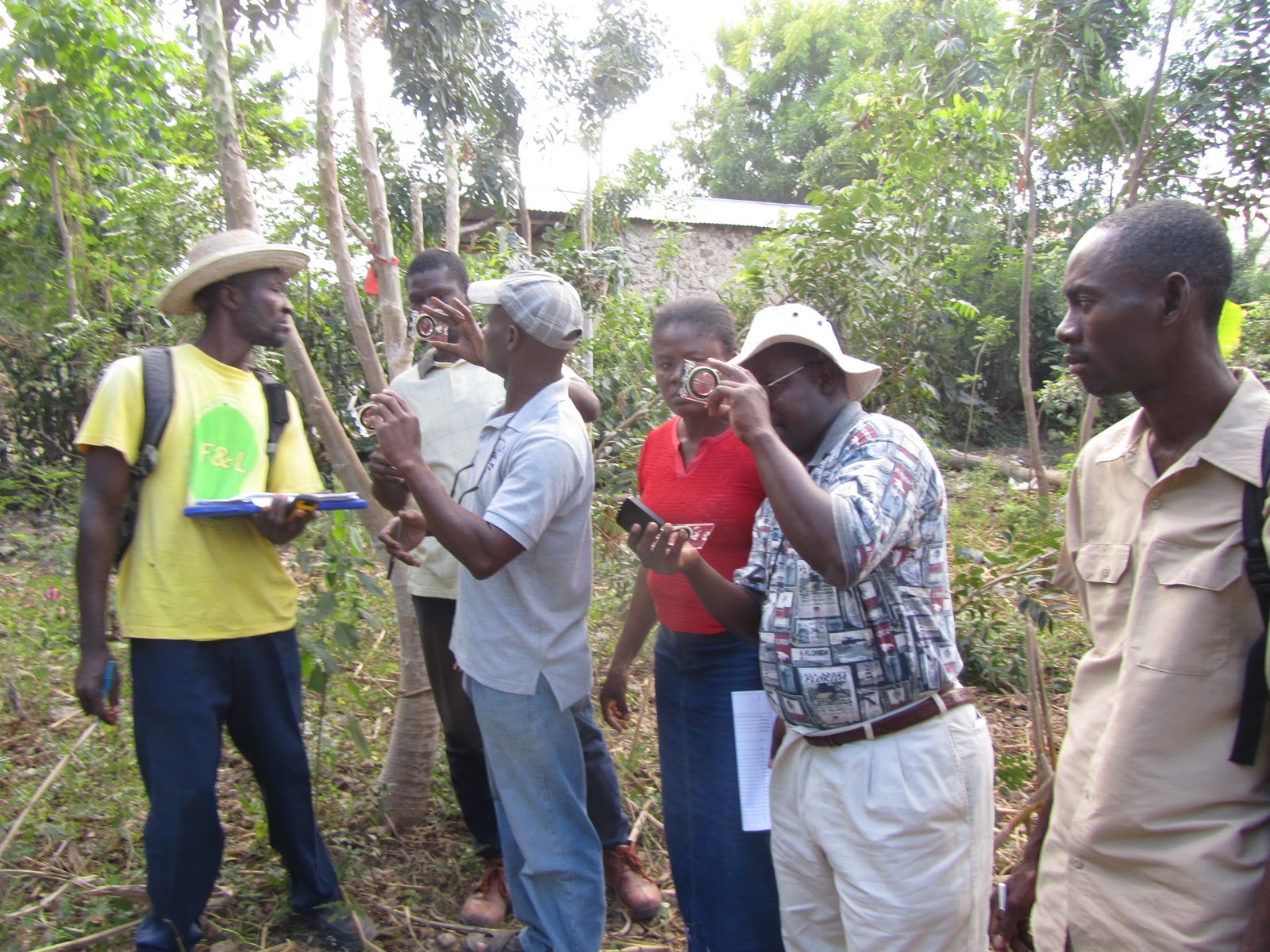
Technicians Alexandre Albertini (left)
and Julson Pharélus (right) record GPS
coordinates at one of our filial plots.
Before we can plant the trees however, our communities are to engage in soil conservation konbits. Konbits are already a part of a Haitian tradition of community members coming together to work on a project followed by a shared meal.  We supply the food for the day while the community does the labor installing soil conservation techniques of rock walls and small canals to combat erosion and allow for maximum retention of rainwater when the dry season comes to an end.
With the New Year well underway, we are making good headway in adding new HTRIP communities. Now that the work of HTRIP is common knowledge in the HAS service area, it is not unusual for communities to make contact with us requesting to join the program. Such was the case with our first new community for 2012, Rondo, near the 2007 community of Titon.  We have several meetings already planned for March with other potential new communities.
When it rains it pours, and February has brought not one, but two interns to the HTRIP team. Ruth Portnoff is joining us for two months on her THIRD visit to HTRIP. She recently completed a yearlong internship with Florida’s ECHO learning about tropical ecology and agriculture – she was an asset to HTRIP in the past, and her value is now increased many fold.  The second intern, Jack Devine, is here in Haiti for the first time. He is taking a gap year before university with Carnegie Mellon University awaiting him in the fall. Both Ruth and Jack have been participating in HTRIPs day-to-day operations - working with staff members on filial plot control, research, and daily nursery activities.
Driver Fenel Plaisil, interns Ruth Portnoff
and Jack Devine, and technician Mathurin Dorcéus
after the long hike to and from Barbes.
Ruth is taking on a few side projects, including helping the technicians organize all the necessary information for implementing our second year trial of shade tolerant crops. Jack has been particularly useful in helping the staff improve their skills on the computer.  Having never used a computer in her life, Marielle Pharèlus is already able to create basic spread sheets using Excel and basic contracts using Word. Shellon Mondèsir is using his newly learned skills with Excel to create spreadsheets that are helping him manage all the tools and food in our new depot. Although they are incredibly quick learners, the process has required a lot of patience because repetition is the key to success of this new skill – and Jack has already proven he is up to the task.
All of this, with the help of our excellent staff and always cheerful interns, has made this a very productive February. We would like to express our sincere gratitude for your help in making this excellent work possible.
The HTRIP Staff,
Including Starry Sprenkle, Ross Bernet, Ruth Portnoff, and Jack Devine

Friday, January 20, 2012

Happy New Year HTRIP Highlights!


Dear Supporters,

The end of the year was a little quieter for HTRIP’s Deschapelles activities. Tool distribution was completed, seed collection has begun, and community nursery work is well underway. As we prepare for the next phase of preparing for tree seedlings, the staff and our communities alike are able to take a moment to celebrate the end of year holidays. A hospital wide party for all HAS employees was a joyful occasion for the members of our staff. 

Pruning to allow light into the new nursery
HTRIP could not have asked for a better gift than the near completion of our new central nursery. The 40-foot shipping container arrived this month that will serve as our new and secure tool and storage depot. The recently completed barbed wire fence reinforced with spiked plants help prevent the goats and chickens from nibbling on our tree seedlings that are ready to get going. A 250 gallon water drum hooked up to the main water line will make watering trees much easier than our previous location. And the covered meeting space is just waiting for the final protective paint job. 

Head nursery gardener Gérard Petit Alberez-Noël
watering large compost piles.

We continued our monthly educational program which focused on plant health in preparation for the nursery tree seedlings which will get going in late January and February.

   The arrival of a GPS unit for each technician meant that we could begin filial plot control to collect data on the past year’s tree plantings. We have already begun with many days of hiking around our newest communities counting trees and collecting site data. 

A new meeting place with a pile of dirt for filling plants
making compost.
   When looking back at the challenges of previous years around this time, I am thankful for how smoothly things have been running here in Deschapelles. We can only hope that the New Year continues down this path as we face the normal struggles of trying to bring trees  to the Artibonite Valley. 

The HTRIP Staff, 
including Starry Sprenkle and Ross Bernet. 


Staff training


A 250-gallon tank in the new nursery

A barbed-wire fence with spikey plants!
New storage depot

Tuesday, November 1, 2011

October HTRIP Highlights!

Dear Supporters,

This month was an exciting one as we continued our education program, distributed tools to community nurseries, broke ground on our new central nursery project, hosted many guests and visitors, and welcomed back a former intern to Deschapelles. This month’s lesson covered tree nurseries, and HTRIP technicians taught community participants about seed germination and care for tree seedlings. They also covered general nursery management principles, like laying out even rows of seedlings for better accounting, and new communities selected a suitable location for their tree nurseries—as near as possible to a water source (for watering seedlings during the dry season), on a slight slope (so that water drains and seedlings do not drown in the rainy season), and with a mixture of sun and shade (so that trees can be acclimated and avoid sunburn). November’s lesson covers tree seed collection and storage.


HTRIP welcomed many guests and visitors in October. Here, intrepid members of the Canadian Friends of HAS disembark in the remote, misty community of Barbe after the grueling 2 1/2 hour drive from Deschapelles.


The education program always corresponds with our community activities, and we spent much of this month purchasing and distributing tools for community nurseries. Each community that participates in the HTRIP program receives basic support for its own nursery, each of which produces between 4,000 and 7,000 trees each year. HTRIP supports community nurseries by subsidizing the material cost of production of the seedlings (the community members do all the work themselves) and by providing simple equipment like picks, shovels, germinating pans, and water drums.


Above: At Mòn Marassa, the steep road to Barbe becomes treacherous and frequently impassable when wet. With the help of HTRIP and other organizations, the local political leader has organized the building of cement bands (below), which will allow HTRIP to reach this remote sixth-section community even in the rainy season.


These are views of the progress on the entire nursery space, including the foundations for the "gazebo" meeting-place structure.


In October, we purchased all of the equipment for the 2011-2012 community nurseries, and we will finish distribution by the second week of November. It is essential to begin community nurseries early in order that trees be ready to plant as soon as the rains begin (the later they are planted, the less they benefit from the rains, and therefore the higher the mortality).


Construction progress on HTRIP nursery water tower foundations.


With this in mind, we also began work on our central HTRIP nursery in Deschapelles this month—and this year, it meant starting construction in a new-to-us space on the Hospital campus which was unused and overgrown until recently (see photo at right). The $13K project will include a small water tower, a “depot” equipment storage space, a wide gate and access road, and a small gazebo like building in which to hold staff meetings. We expect this new nursery space to meet all of HTRIP’s needs for the foreseeable future, and immediately it will allow us to increase our nursery production to more than 80,000 trees this year at the same time that it allows us the space for a larger central composting operation and a grasses program. This month, we finished most of the foundations (see photos). We expect to finish the major construction work by the end of November and have everything else in place and fully operational by the end of the year.

Among the many guests and visitors we welcomed to Deschapelles this month was Ross Bernet, a recent graduate of UCLA in environmental science who completed an internship with HTRIP in the summer of 2010 researching the effects of geospatial human and ecological factors on tree growth in HTRIP filial plots. This year, he will be contributing more to project logistics and long-term management strategy while he continues his research.

Construction progress on the HTRIP nursery. Above, foundations are being built for the forty-foot shipping container that will serve as a "depot" storage space.

Although we suffered from a shortened rainy season this summer, we’ve been benefitting from an unusually wet “second rainy season”, so we hope that tree mortality this year will not be as high as we originally thought. HTRIP staff will soon begin the long process of surveying the over eight hundred new “filial” tree plots this year, and we will know for sure in the early months of 2012.

We look forward to an exciting and productive November and thank you all for your continuing support,

The HTRIP Staff,
including Starry Sprenkle, Dan
Langfitt and Ross Bernet.

Friday, October 14, 2011

New Photos from the Philip Craig Arts Program!


This program is graciously sponsored by a grant from Grapes for Humanity Click on the lower right hand corner for full-screen mode, and then "Show info" for image captions.

Tuesday, October 11, 2011

2011 H'Art & Soul of Haiti Slideshow!

HTRIP September Highlights!

Dear Supporters,

This month was a quieter one for HTRIP’s Deschapelles activities. We continued our monthly  educational program, collected broken tools and assembled community nursery inventories, and visited a mangrove restoration project the northern part of Haiti.

Paul Tompkins, a specialist in marine restoration ecology, left a grateful HTRIP staff in the middle of the month, but not before leading a trip to Bas Limbé, a small town on Haiti’s northern coast where USAID-DEED sponsored a mangrove restoration project that restored several kilometres of coastline before its funding ended this year. Before the trip, Paul gave a presentation for HTRIP staff about the importance of mangroves, which are not only an important habitat for fish but also an essential part of the overall ecological health of any coastal area. Just as trees prevent erosion from hillsides, mangroves act as a sediment trap that prevents topsoil from washing into the ocean—this type of erosion not only reduces fertility on land, but can suffocate coral reefs and disrupt marine ecosystems. Although the people in Bas Limbé work in a very different context than we do (on the beach instead of in the mountains), many of the concepts—like soil conservation—are the same for both of us, and the HTRIP staff benefited from seeing these same concepts applied in a different place. Other practices in Bas Limbé—like the “community watch” partnership with local authorities to prevent people from cutting down the new mangrove trees—may hold promise for the area that HTRIP serves. 

This month's education topic was compost. The infertility of the soil in HTRIP communities means that composting is essential for planting trees—and just about anything else—in rocky, inhospitable conditions. HTRIP has always taught composting, but this year we have undertaken an initiative to encourage and enable all of our community nurseries to build and maintain a large, central compost pile. October’s education topic is nursery construction and management, in preparation for the beginning of our central and community tree nurseries in November.

While technicians were teaching and demonstrating composting techniques, they were also collecting broken tools and taking inventories of community nurseries. Just as we hope to begin construction on our new central nursery this month, we will purchase and distribute the nursery materials we provide each year to our community nurseries.

We look forward to a busy month ahead. It was a pleasure to see so many of you at the Friends of HAS Gala in early September, and we thank you all for your continuing support,

The HTRIP Staff,
including Starry Sprenkle and Dan Langfitt

Friday, October 7, 2011

HTRIP: A Year in Review

Dear Supporters,
August saw the completion of tree distribution and planting, a preliminary tool inventory to prepare for an earlier start of this year’s tree nurseries, a final graduation ceremony for HTRIP’s literacy program, a continuation of our monthly education program, and our annual staff retreat to the beach where we focused on developing a long-term strategic plan for the project. 

Learning to read
HTRIP hopes to eventually turn impoverished mountain villagers into tree farmers who market timber products to generate enormous increases in household income and standard of living.  One barrier to success is the fact that most of our program participants are illiterate and therefore extremely vulnerable in the marketplace (in a business transaction, it is easy to take advantage of someone who can neither read nor add numbers).

Teaching adult literacy to help make our participants better businessmen, then, was the logic behind the separately-funded and relatively independent program begun in 2007 under the leadership of Agathe Généus, a dynamic an innovative teacher and community mobiliser.  Since then, Agathe has been bringing her unique curriculum far into HTRIP’s mountain communities.

On the 11th of August, we celebrated the achievements of those members of HTRIP communities who completed the two-year literacy program.  At a graduation ceremony not far from the location at Drouin where we held one of the HTRIP agro-forestry graduation ceremonies last May, each community prepared a song, dance, or skit about the importance of literacy—and all of them featured new graduates reading aloud in front of the entire group.  Unfortunately, funding is no longer available to continue this program, but the learning is not over.  HTRIP’s philosophy stresses community empowerment, and Agathe’s work involved training local instructors to go back to their respective communities to teach literacy to their comrades.  We are confident that even though the formal program has concluded, its impact will not end now.  We hope that it will continue for years to come and prepare our participants for the marketplace.
Everyone on the HTRIP team is enormously grateful to Agathe for her important contribution to our mission, and we will keep her onboard as an informal consultant until another lucky program lures her away from ours. 


HTRIP gets greener
Since clean drinking water is difficult to get around Deschappelles, most Haitians (at least when they are out and about at the market or at work) hydrate with purified water sold in small quarter-litre plastic bags on the streets for a few gourdes.  Predictably, the used and discarded water bags (sache dlo in Creole) litter the streets.  This month, HTRIP began reimbursing locals for collecting these sache dlo for eventual use in HTRIP central and community nurseries as growing containers for our tree seedlings.  We pay 25 gourdes (about $0.50) per 100 sache dlo, compared to 120 gourdes (on average) for the more expensive black seed bags we used to buy in Port au Prince.  Although the difference (about $2 saved per 100 bags) seems small, when you consider that we plan to acquire nearly 350,000 tree seedling bags this year, it amounts to considerable savings… and the only side effect is and pocket money for the entrepreneurial Artibonite children collecting the sache dlo, not to mention less littered streets.

Passing the half-million mark (with ninety-thousand to spare)
While the literacy program concluded, the regular HTRIP tree-planting work continued to roll forward.  HTRIP staff personally moved 31,085 trees in July and August, mostly from our central nursery in Deschappelles, but also to some extent among communities in the mountains.  Much more significant is the number of trees that communities produced and planted for themselves: all told, we produced and planted 221,139 trees this year, by far our most productive year to date, bringing our grand total to 591,888 trees since 2006.  At this rate (we intend to produce and plant more than 300,000 this coming year alone), we will be well passed the one-million mark by the end of 2013.

Planning for HTRIP’s future
Speaking of planning for the future, HTRIP is proud to announce the progress it has made in its long-term strategic planning.  On the 17th of August, HTRIP staff gathered with its consultants for a day-long brainstorming session at a beach resort near Saint Marc to set concrete goals and policies for 2011-2012 and design a long-term HTRIP strategy.  The Year 6 strategic plan evaluates program performance since 2005, articulates specific targets for this fiscal year, and outlines a long-term strategy for HTRIP over the next fifteen years.  The final document will be available in mid-September, but here are some of the highlights:

   2005-2011 accomplishments:
    • Educated 2,818 men and women about agro-forestry and helped them plant more than half a million trees and construct more than 100 kilometres of soil conservation;
    • Built a tightly-knit team of consultants, drivers, and agro-forestry technician/extension agents;
    • Developed a solid model for agro-forestry education, tree plantation, and soil conservation flexible enough to sustain in the long term; and
    • Dramatically improved operational efficiency (in 2006-2007, we required nearly five dollars in our annual budget for every tree planted under the HTRIP aegis; in 2010-2011, that figure dropped to nearly one dollar).
   2011-2012 project goals:
    • Continue our successful tree-planting programme with 44 active communities, graduating more than 1,000 participants and planting as many as 350,000 trees, including work in the remote and inaccessible 6th section of Verrettes (localities like Barbe, La Bonne, Terre Nette, Gabriel, etc.), where we will need to adapt our programme to the area’s geographical and logistical limitations;
    • Convert 85% of the seedling containers that HTRIP uses to the cheaper and more eco-friendly sache dlo “water bags” and reduce the targeted cost per tree produced by 25% compared to 2010-2011;
    • Build a larger and better nursery (see right) that will give HTRIP more efficiency for materials management and distribution, and—more importantly—afford it the space to develop a grasses initiative and experiment with several new tree species;
    • Expand last year’s shade-crop trial to 6-12 more communities to continue our initiative to make HTRIP tree plots more productive until they are ready for harvest;
    • Offer regular staff development opportunities so that HTRIP staff is prepared to better contribute to the new programmes we are developing; and
    • Engage in another year of successful collaboration with the Yale School of Forestry and Environmental Studies on long-term HTRIP goals (see below).


Thank you all for your continuing support,
 The HTRIP Staff,
including Starry Sprenkle, Dan Langfitt, and Paul Tompkins